

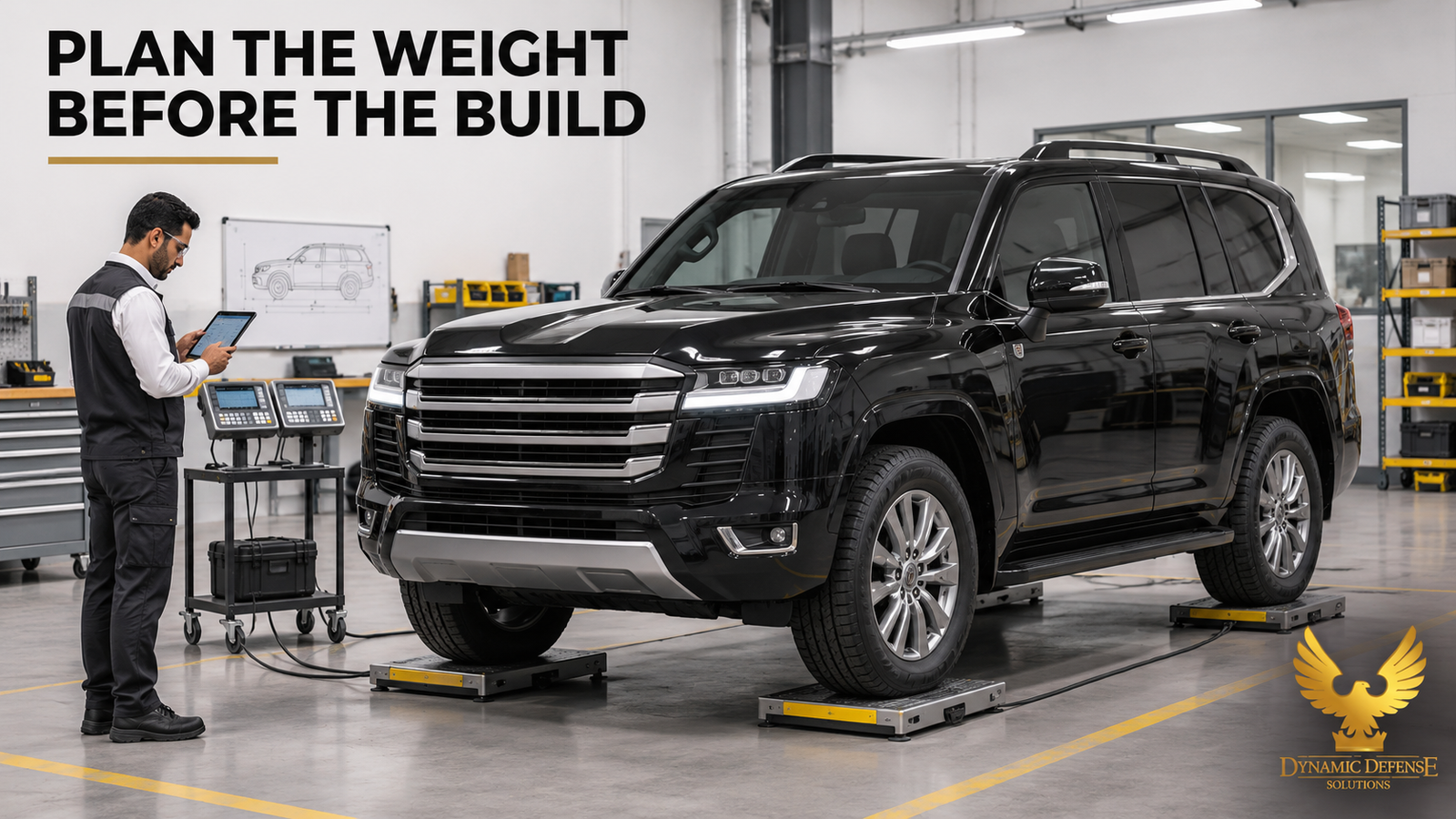

Armored Vehicle Weight Budget: Why Added Mass Must Be Planned Before the Build
Adding protection to a vehicle is not simply a matter of installing ballistic steel and replacing the original glass. Every protective component adds mass, and the location of that mass changes how the vehicle accelerates, stops, steers, handles heat and carries passengers.
A properly prepared armored vehicle weight budget gives the converter a working picture of the expected finished vehicle before production begins. It connects the protection package with axle capacity, suspension selection, brake performance, tyres, wheels, run-flat systems and door hardware.
Without this calculation, a vehicle can appear acceptable while stationary but perform poorly under braking, cornering or rough-road use. The problems may only become visible after the glass, steel, interior and accessories have already been installed—when corrections are more expensive.

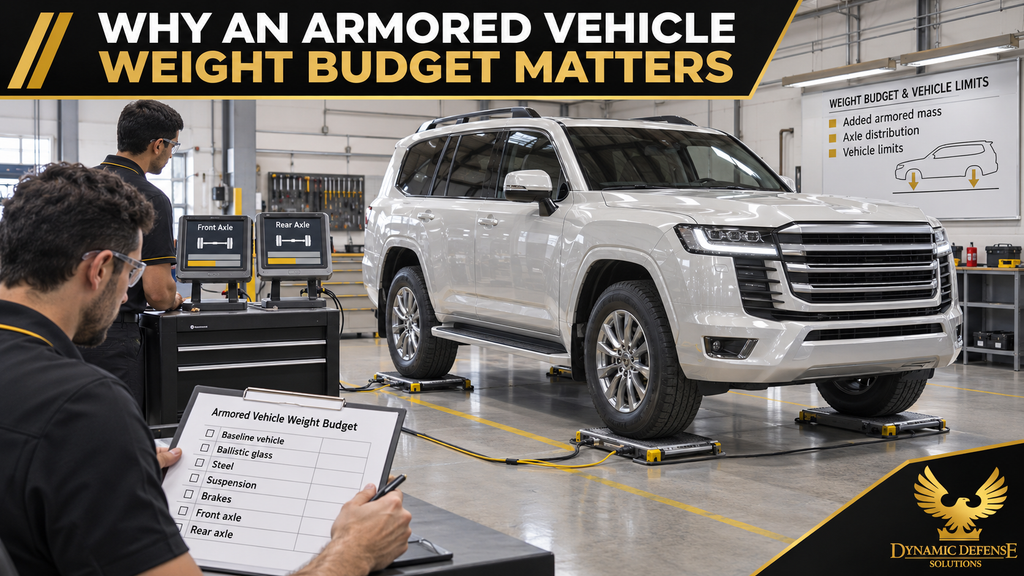
Why an Armored Vehicle Weight Budget Matters
The total added weight is important, but it is only one part of the calculation. A 700 kg increase distributed evenly across a long-wheelbase vehicle does not create the same engineering problem as 700 kg concentrated around the front doors, firewall and windshield.
An armored vehicle weight budget should therefore answer four questions:
- What is the verified weight of the base vehicle?
- How much mass will each protection component add?
- Where will that mass be positioned?
- What will the estimated front and rear axle loads be when the vehicle is complete?
This information affects far more than the choice of springs. It helps determine whether the proposed build remains compatible with the vehicle platform, its intended payload and its operating environment.
Protection level also cannot be evaluated by weight alone. Different material combinations, glass constructions and overlap designs may produce different mass distributions even when they are intended for a similar threat requirement.
Begin with the Actual Base Vehicle
Brochure kerb weight is useful for early planning, but it should not replace measurement of the actual vehicle whenever the project allows it.
Vehicle trim, engine, drivetrain, fuel level, seating layout, factory options and installed accessories can all change the starting weight. Two vehicles carrying the same model name may not begin the conversion at the same mass.
The first version of the armored vehicle weight budget should record:
| Required data | Why it matters |
|---|---|
| Actual total vehicle weight | Establishes the real starting point |
| Front axle weight | Shows available front-axle margin |
| Rear axle weight | Shows available rear-axle margin |
| GVWR or permitted total mass | Provides the manufacturer-rated limit |
| Front and rear GAWR | Identifies axle-specific capacity |
| Intended occupants and equipment | Prevents protection from consuming the usable payload |
| Fuel condition during weighing | Keeps before-and-after measurements comparable |
GVWR is the manufacturer-specified loaded weight rating, while GAWR represents the rated load-carrying capacity of an individual axle system. Certification labels commonly identify these figures separately because remaining below the total rating does not automatically mean that each axle is within its limit. TP-110T-01
For international projects, the applicable local approval and vehicle-category requirements must also be checked. Manufacturer ratings and regulatory limits should not be treated as interchangeable.

Calculate the Added Mass by Component
A useful armored vehicle weight budget is built from component-level information rather than one rough estimate for the complete protection package.
Typical categories include:
- Ballistic windshield and door glass
- Rear and quarter glass
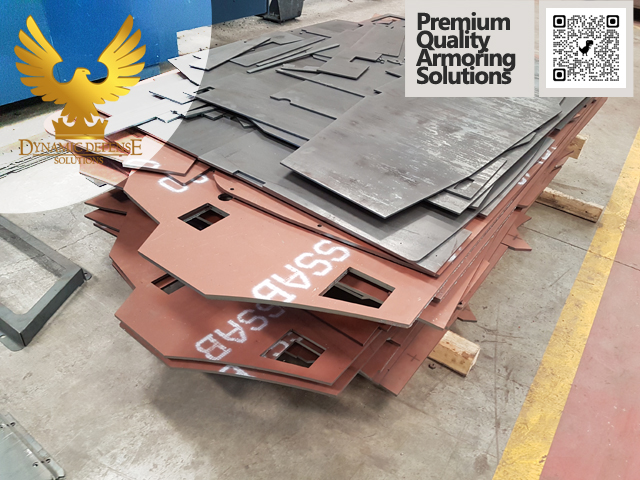
- Ballistic steel or composite protection
- Door overlap and pillar reinforcement
- Roof and floor protection
- Door hinges and reinforcement plates
- Window actuators and support mechanisms
- Run-flat inserts
- Suspension components
- Brake-system components
- Battery, communication or emergency equipment
- Interior finishing materials
- Final passengers, tools and operational cargo
The calculation should use confirmed component weights wherever possible. If a final component has not yet been selected, the estimate should be marked as provisional rather than presented as confirmed project data.
A practical worksheet should also include a contingency allowance. Small brackets, sealants, fasteners, wiring, trim modifications and reinforcement parts can create a noticeable difference when combined across the vehicle.

An Armored Vehicle Weight Budget Must Show Location
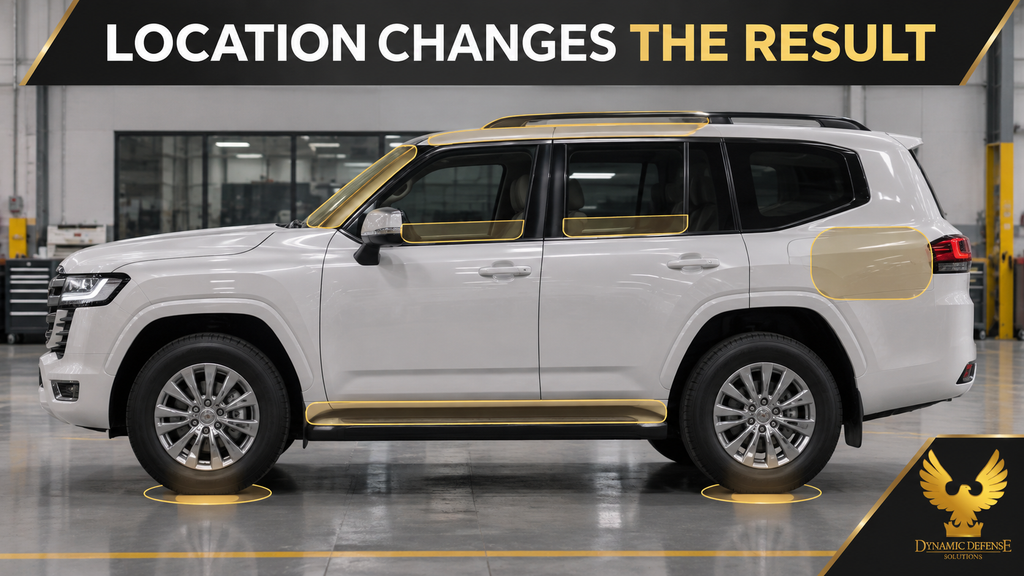
Mass must be assigned to the area where it will actually be installed.
Ballistic glass is positioned relatively high in the vehicle. Door protection is concentrated on the sides. Firewall and windshield upgrades influence the front axle, while rear cargo-area protection may move more of the load behind the vehicle’s centre.
This is why the armored vehicle weight budget should separate at least the following areas:
Front and Rear Distribution
A vehicle can remain below its planned finished weight while still carrying too much load on one axle. Heavy windshield glass, front-door protection, firewall steel and engine-bay components can use the front-axle margin quickly.
Rear protection, additional seats, spare wheels, equipment and cargo must also be considered together rather than as independent items.
Left and Right Balance
Side-to-side differences may occur because of fuel tanks, batteries, driver position, communication systems or equipment storage. Significant imbalance can influence ride height, handling and spring selection.
Height of Added Mass
Weight installed in the roof, windows and upper door sections raises the centre of gravity. The total figure on the scale may be acceptable, but the vehicle may still demonstrate increased body roll and slower transient response.
Select Components After Establishing the Weight Budget
An armored vehicle weight budget should guide component specification. It should not be produced afterward merely to document parts that have already been purchased.
Heavy-Duty Suspension
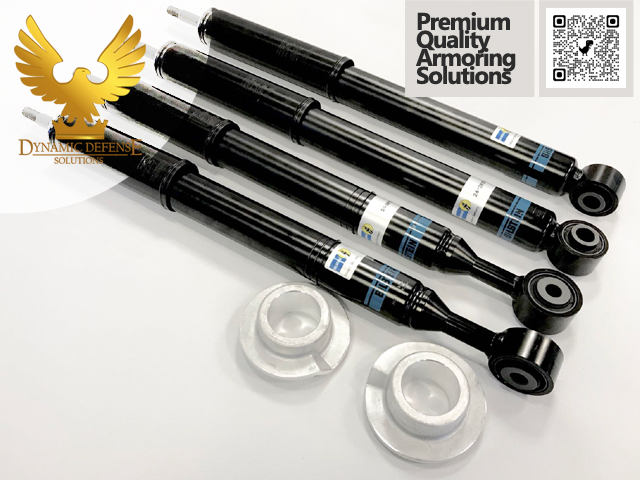
Spring and shock selection should be based on expected front and rear operating loads—not only the vehicle name or a general “armored vehicle” description.
Springs primarily carry the static load and control ride height. Dampers manage suspension movement. Sway bars influence roll control. These components work together, but they do not perform the same function.
Installing extremely stiff springs without matching the real axle load can create poor ride quality, reduced wheel compliance and unnecessary stress. An underspecified system can allow sagging, frequent bottoming and unstable handling.
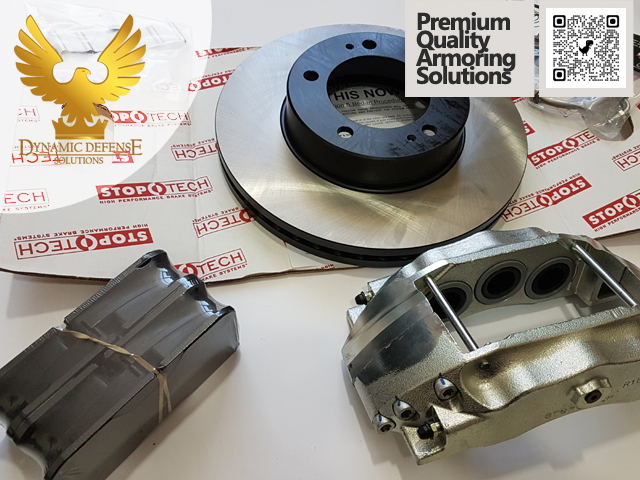
Braking System
Additional vehicle mass increases the energy that the braking system must manage. Repeated stops can generate more heat in discs, pads and brake fluid, particularly in hot climates, mountainous routes or security-driving conditions.
The armored vehicle weight budget therefore becomes part of the brake-upgrade discussion. Rotor size, caliper capacity, pad characteristics, wheel clearance, tyre grip and brake balance must be considered as a system.
Passenger-car braking approval requirements are addressed internationally under UN Regulation No. 13-H, illustrating why braking performance should be treated as a complete vehicle function rather than a standalone component claim. View UN Regulation No. 13-H on passenger-car braking. UNECE
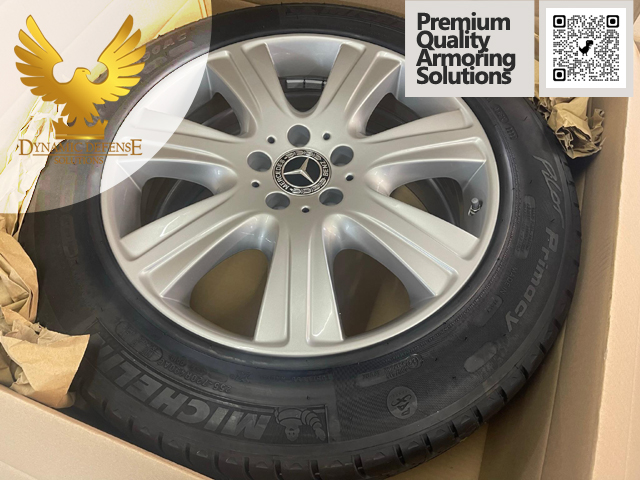
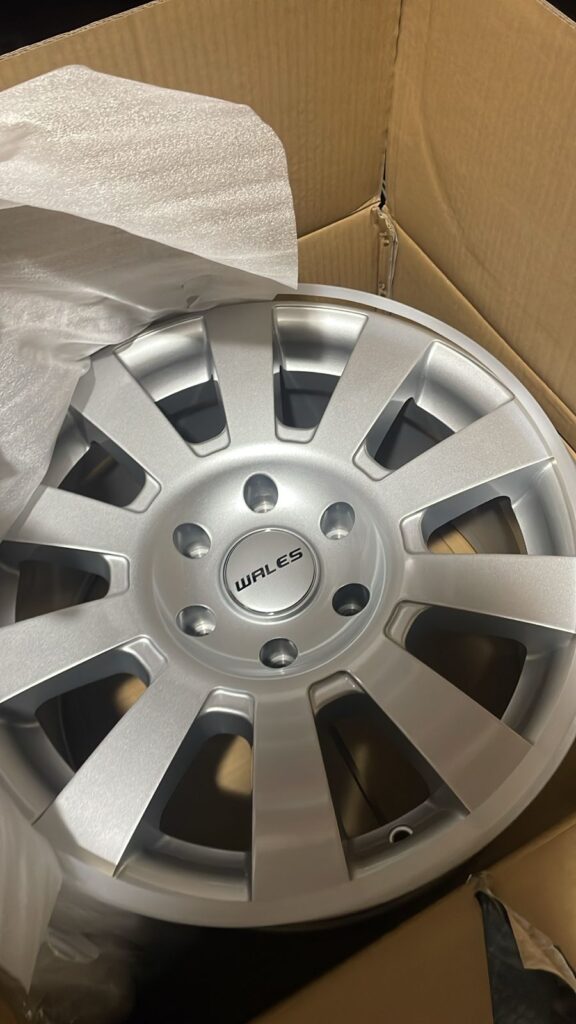
Tyres, Wheels and Run-Flat Systems
Tyre load rating must be checked against expected axle loads and operating pressure. Wheel load capacity and dimensional compatibility also matter.
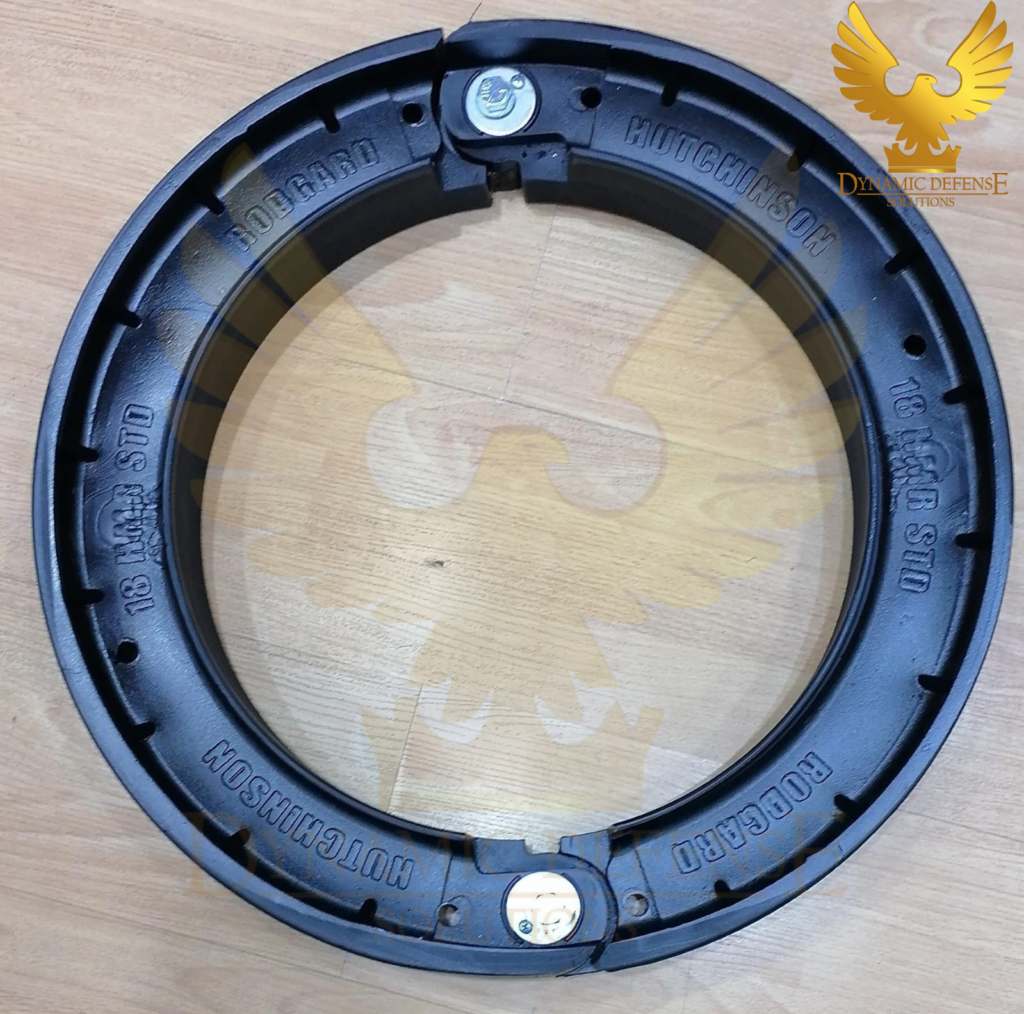
A run-flat insert should not be selected by nominal wheel diameter alone. Rim profile, bead-seat geometry, tyre dimensions, internal clearance and expected load must be confirmed.
The completed armored vehicle weight budget gives the supplier essential information when assessing wheel and run-flat compatibility.
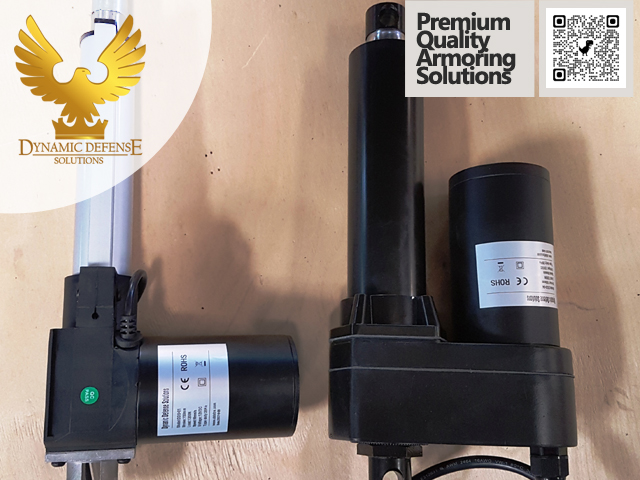
Doors, Hinges and Window Actuators
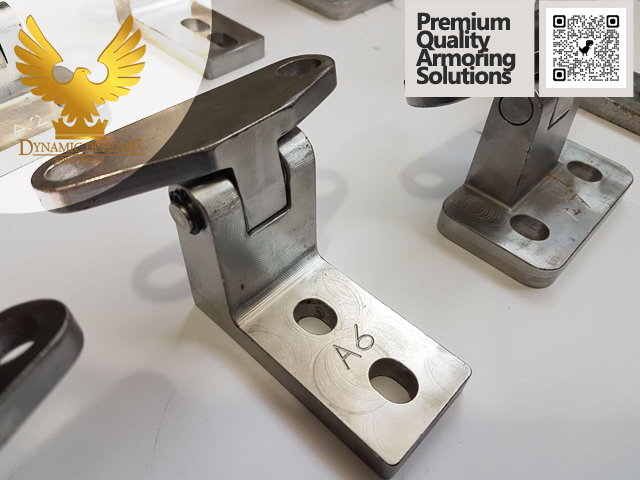
Ballistic door glass and steel protection increase both the total door mass and the bending moment acting on the hinge area.
The door’s weight, width and centre of mass influence hinge load. Window actuators must also be matched to the actual glass weight, available installation space, travel requirement and door geometry.
Simply specifying that the vehicle is “B6” or “BR6” does not provide enough information for correct hardware selection.

Static Weight Is Not the Whole Story
An armored vehicle weight budget begins with static measurements, but real vehicles operate dynamically.
During braking, load transfers toward the front axle. During acceleration, it moves rearward. Cornering transfers load laterally, while potholes and off-road impacts create short-duration forces considerably higher than the static load.
Added mass may influence:
- Steering response
- Body roll
- Brake temperature
- Suspension travel
- Tyre loading
- Wheel-bearing life
- Door alignment
- Chassis fatigue
- Approach and departure behaviour
- Emergency manoeuvring
For this reason, a completed spreadsheet is a planning tool—not a substitute for engineering inspection and vehicle-level validation.

Verify the Vehicle During and After Conversion
The armored vehicle weight budget should be updated as the project progresses. If actual component weights differ from the estimates, the calculation must be revised before the difference becomes part of the completed vehicle.
Recommended verification stages include:
- Weigh the base vehicle in a defined fuel condition.
- Record front and rear axle weights.
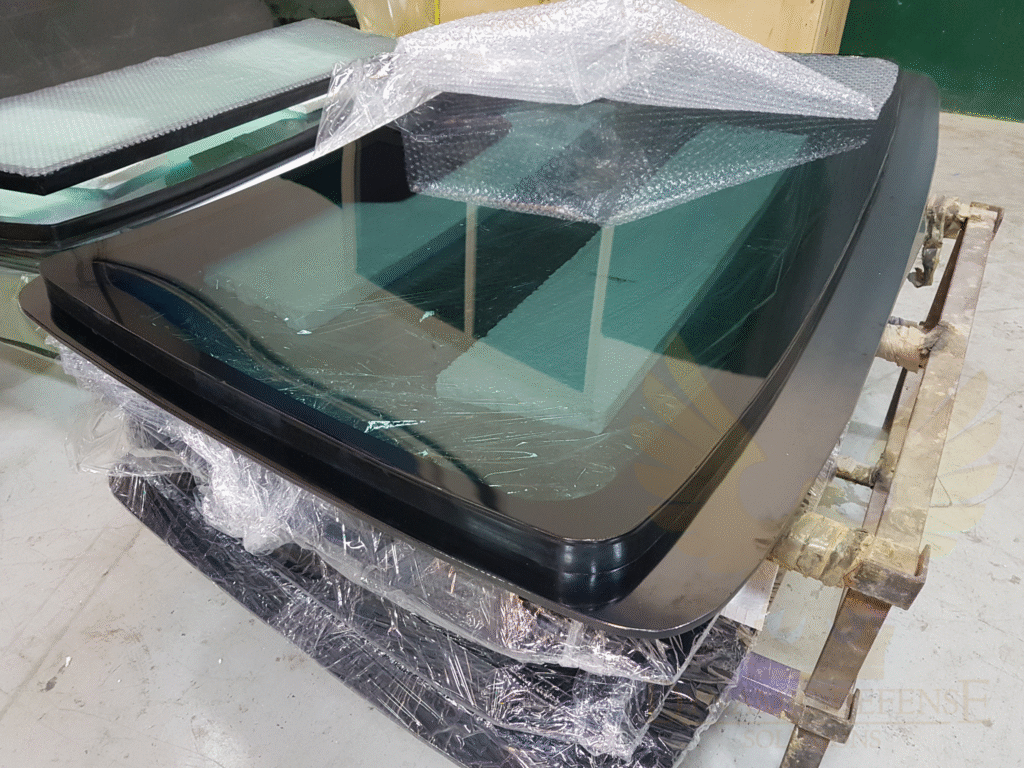
- Confirm the weight of major glass and protection components.
- Reweigh after the primary protection package is installed.
- Add expected occupants, fuel, cargo and operational equipment.
- Check finished axle loads and ride height.
- Inspect wheel alignment and available suspension travel.
- Conduct controlled braking, handling and road evaluation.
- Recheck door alignment and closing effort.
- Record the final configuration for maintenance and future replacement parts.
The complete vehicle must be evaluated as a system. Certification of individual glass, steel or other materials does not by itself confirm the protection level, roadworthiness or dynamic performance of the finished vehicle.

Information to Send Component Suppliers
A clear armored vehicle weight budget also improves quotations and reduces technical back-and-forth with suppliers.
For relevant projects, buyers should provide:
- Vehicle make, model, year and variant
- VIN or clear vehicle identification where appropriate
- Protection requirement
- Base vehicle and estimated finished weight
- Front and rear axle loads
- Weight of individual doors and glass pieces
- Tyre and wheel specifications
- Rim profile or physical rim for run-flat assessment
- Intended passenger and cargo load
- Operating environment
- Relevant drawings, templates and photographs
Supplying this information early helps manufacturers and component suppliers evaluate compatibility before production.
How Dynamic Defense Solutions Supports Project Planning
Dynamic Defense Solutions supplies specialized armored vehicle components for international projects. Depending on project requirements, DDS can support manufacturers, converters, integrators and workshops with ballistic glass, ballistic steel, heavy-duty suspension, braking solutions, run-flat systems, machined door hinges, window actuators and related components.
DDS does not treat one component as a complete vehicle solution. Relevant project data—including vehicle variant, protection requirement, expected finished mass, axle loads and dimensional information—helps the team assess suitable component options.
An armored vehicle weight budget makes this process more precise. It allows the buyer and supplier to discuss the real operating vehicle rather than relying only on the base model name or a general protection-level description.
Conclusion
A well-prepared armored vehicle weight budget should be created before materials and supporting components are finalized. It identifies where the added mass will be positioned, how much payload remains and which vehicle systems may require attention.
For armored vehicle manufacturers, converters, workshops, security-vehicle companies and project integrators, early weight planning can reduce rework, component mismatch and unexpected handling problems.
To discuss component requirements for an upcoming protected-vehicle project, contact Dynamic Defense Solutions with the vehicle details, intended protection requirement and available weight data.

Send Us Your Inquiries Today
SIMILAR PRODUCTS
SUCCESSFULL STORIES
LOGISTICS SERVICES
Supply Chain is core of our operational efficiency providing logistics services anywhere in the world for Armored cars and Armored cars parts. To date we have successfully shipped our products to many countries around the Globe. Our supply chain is supported by a dedicated team of highly capable and experienced logistic professionals. Offering freight by air, land or sea within efficient time frame
HAVE SUCCESSFULLY SHIPPED OUR ARMORED CARS PARTS TO MANY COUNTRIES AROUND THE GLOBE

RELATED BLOGS
Armored Vehicle Parts Ukraine: Complete Guide for TLC 76, 78, 79, Hilux & L200
Armored Vehicle Suspension Systems: Why They Matter More Than You Think
Prado 250 Armored Car Parts & Protection Kit